In modern steelmaking operations, the steel ladle is not merely a transport vessel for molten steel. It is a high-temperature metallurgical reactor subjected to severe thermal, chemical, and mechanical stresses during every heat cycle. The operating life of the ladle refractory lining—commonly referred to as the ladle campaign life—has a direct impact on production cost, steel quality, plant productivity, safety, and refractory consumption.
Increasing ladle campaign life has become one of the most important objectives in integrated steel plants, mini mills, and continuous casting operations. Extending campaign life reduces refractory replacement frequency, minimizes downtime, improves thermal efficiency, and stabilizes metallurgical performance.
However, ladle lining wear is a complex phenomenon. It depends not only on refractory quality, but also on operational discipline, slag chemistry, thermal practice, argon stirring conditions, steel grade requirements, and process control throughout the steel shop.

This article provides a detailed metallurgical and operational analysis of how to increase ladle campaign life using practical steelmaking approaches.
1. Understanding Ladle Campaign Life
Ladle campaign life refers to the total number of heats a ladle can safely complete before the refractory lining requires major repair or replacement.
A typical steel ladle contains several refractory zones:
- Slag line
- Working lining
- Impact zone
- Bottom lining
- Freeboard area
- Well block and nozzle area
Each zone experiences different wear mechanisms. The slag line generally suffers the highest wear because of intense chemical corrosion and thermal cycling.
The main factors controlling ladle life include:
- Slag chemistry
- Temperature profile
- Steel grade
- Stirring practice
- Carryover slag
- Thermal shock
- Holding time
- Refractory selection
- Operational stability
Increasing campaign life therefore requires a comprehensive and disciplined process-control strategy.
2. Control Slag Carryover
One of the most important factors affecting ladle refractory wear is slag carryover from the furnace.
2.1 Effects of Slag Carryover
Converter or EAF slag typically contains:
- High FeO
- High MnO
- Aggressive oxidizing oxides
When excessive slag enters the ladle:
- Oxidation potential increases
- MgO-C bricks suffer severe oxidation
- Slag penetrates refractory pores
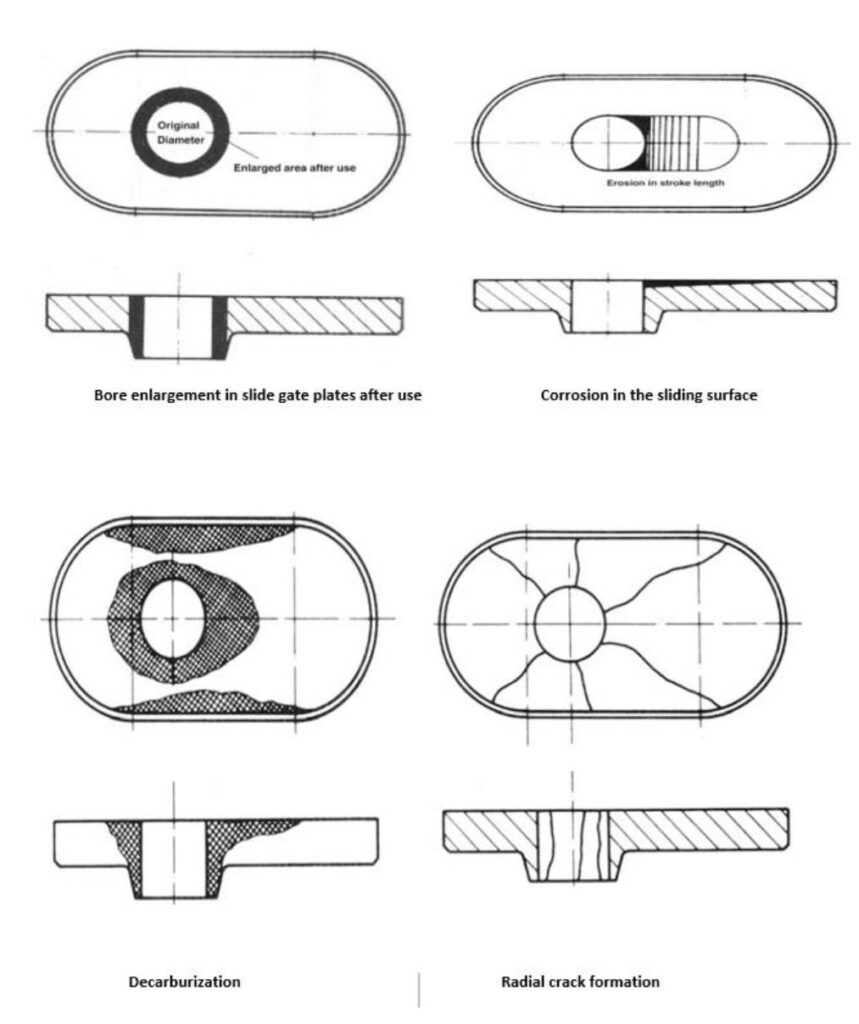
- Decarburization accelerates
- Chemical corrosion intensifies
High FeO slag is especially destructive to carbon-containing refractories.
The main reactions include: FeO+C→Fe+COFeO + C \rightarrow Fe + COFeO+C→Fe+CO
This reaction consumes the graphite phase in MgO-C bricks, weakening the refractory structure.
2.2 Methods to Reduce Slag Carryover
Steel plants commonly use:
- Slag darts
- Electromagnetic slag detection
- Automatic tapping systems
- Slag stoppers
- Proper tapping angle control
Reducing carryover slag significantly improves refractory life by lowering oxidation and corrosion.
Even a small reduction in FeO entering the ladle can dramatically increase campaign performance.
3. Optimize Slag Chemistry
The chemistry of refining slag is one of the most critical factors influencing ladle wear.
3.1 Importance of Basicity
Ladle slags must maintain proper basicity: Basicity=CaOSiO2Basicity = \frac{CaO}{SiO_2}Basicity=SiO2CaO
Optimized slag basicity helps:
- Protect MgO-C lining
- Reduce chemical dissolution
- Improve desulfurization
- Stabilize slag viscosity
Low-basicity slags aggressively attack magnesia refractories.
3.2 Maintain Low FeO and MnO
Excess FeO and MnO increase oxidation potential and destroy graphite-containing refractories.
High oxidizing slags cause:
- Carbon oxidation
- Structural weakening
- Increased slag penetration
- Accelerated slag-line wear
For long ladle life, steel plants should maintain:
- Low FeO
- Low MnO
- Controlled oxygen potential
3.3 Saturation with MgO
Maintaining MgO saturation in the slag reduces dissolution of MgO-C bricks.
When slag becomes undersaturated in MgO:
- It dissolves refractory MgO
- Brick wear accelerates
- Slag-line thinning becomes severe
Proper slag conditioning minimizes refractory consumption.
4. Optimize Argon Stirring Practice
Argon stirring is essential in secondary metallurgy for:
- Temperature homogenization
- Inclusion flotation
- Alloy mixing
- Desulfurization
However, excessive stirring damages the ladle lining.
4.1 Effects of Excessive Stirring
High argon flow rates produce:
- Severe turbulence
- Mechanical erosion
- Slag-metal emulsification
- Exposure of slag line to dynamic attack
Excessive stirring can also create localized wear near porous plugs.
4.2 Optimized Stirring Control
The goal is not maximum stirring—but optimum stirring.
Plants should:
- Maintain stable argon flow
- Avoid sudden pressure spikes
- Adjust stirring according to steel grade
- Monitor plug performance
Controlled stirring minimizes mechanical erosion while maintaining metallurgical efficiency.
5. Reduce Ladle Holding Time
Long holding time is extremely harmful to ladle refractory life.
5.1 Why Long Holding Time Causes Wear
When molten steel remains in the ladle for extended periods:
- Thermal exposure increases
- Slag reactions continue longer
- Oxidation intensifies
- Heat penetrates deeper into lining
Long residence time especially damages:
- Slag line bricks
- Working lining
- Bottom refractory
5.2 Operational Improvements
Campaign life can be increased through:
- Efficient process scheduling
- Reduced waiting time before casting
- Better synchronization between LF and caster
- Faster steel transfer operations
Shorter holding time reduces both thermal and chemical wear.
6. Proper Ladle Preheating
Preheating is critical for refractory stability and thermal shock prevention.
6.1 Consequences of Poor Preheating
Insufficient preheating causes:
- Thermal shock cracking
- Moisture-related spalling
- Refractory fracture
- Steel temperature loss
Cold ladles experience severe stress when exposed to molten steel at 1600°C.
6.2 Proper Preheating Practice
Effective preheating requires:
- Uniform temperature distribution
- Controlled heating rate
- Sufficient soaking time
- Proper burner adjustment
Modern plants use automated preheating stations to maintain consistency.
7. Protect the Slag Line
The slag line is usually the most heavily damaged area in the ladle.
7.1 Why Slag Line Wear Is Severe
The slag line experiences:
- Chemical corrosion
- Thermal cycling
- Oxidation
- Mechanical turbulence
Repeated contact with aggressive slag causes rapid degradation.
7.2 Slag Line Protection Methods
Common protection strategies include:
High-Quality MgO-C Bricks
These bricks provide:
- Excellent corrosion resistance
- Thermal shock resistance
- Good structural integrity
Slag Coating Practice
After tapping, a thin slag layer is intentionally coated onto the refractory surface.
Benefits include:
- Reduced direct slag attack
- Improved thermal insulation
- Lower oxidation rate
Regular Wear Monitoring
Laser scanning and visual inspections help identify critical wear zones before failure occurs.
8. Minimize Thermal Shock
Thermal shock is one of the most destructive refractory damage mechanisms.
8.1 Causes of Thermal Shock
Rapid temperature changes occur during:
- Empty ladle cooling
- Reheating cycles
- Sudden steel charging
- Water exposure
These conditions generate:
- Crack formation
- Spalling
- Structural weakening
8.2 Thermal Shock Prevention
Plants should:
- Avoid rapid cooling
- Control heating rate
- Prevent water contact
- Maintain stable operational temperatures
Stable thermal conditions significantly improve campaign life.
9. Improve Operational Discipline
Many refractory failures are operational—not material-related.
9.1 Human and Process Factor
Poor operational discipline includes:
- Improper slag practices
- Incorrect argon flow
- Delayed casting
- Mishandling during repair
- Excessive oxygen lancing
Even high-quality refractories fail quickly under poor operating conditions.
9.2 Standardized Practices
Steel plants should implement:
- SOP-based operation
- Refractory inspection protocols
- Operator training
- Real-time process monitoring
Consistent operation improves both refractory life and steel quality.
10. Advanced Technologies for Ladle Life Improvement
Modern steel plants increasingly adopt advanced technologies to optimize campaign life.
10.1 Laser Ladle Scanning
Laser systems measure lining thickness and wear profile in real time.
Benefits:
- Predictive maintenance
- Early wear detection
- Improved repair planning
10.2 AI and Digital Monitoring
Artificial intelligence systems analyze:
- Temperature profiles
- Slag chemistry
- Heat cycles
- Wear trends
This enables optimized operational decisions.
10.3 Improved Refractory Materials
New refractory technologies include:
- Nano-carbon additives
- Antioxidant systems
- High-purity fused magnesia
- Spinel-enhanced refractories
These materials offer:
- Better oxidation resistance
- Lower slag penetration
- Improved thermal shock performance
11. Economic Benefits of Longer Ladle Campaign Life
Increasing ladle life provides major financial advantages:
- Reduced refractory consumption
- Lower maintenance cost
- Increased ladle availability
- Reduced downtime
- Improved casting productivity
- Better steel cleanliness
Even a 10–15% improvement in campaign life can generate significant annual savings.
12. Conclusion
Increasing ladle campaign life requires a combination of metallurgical understanding, refractory optimization, and strict operational discipline. The most important factors include:
- Minimizing slag carryover
- Controlling slag chemistry
- Optimizing argon stirring
- Reducing holding time
- Proper preheating
- Protecting the slag line
- Minimizing thermal shock
- Maintaining process discipline
Ultimately, ladle life is not controlled solely by refractory quality—it is controlled by the entire steelmaking process. Even small operational improvements in slag control, FeO reduction, stirring optimization, and thermal management can significantly extend ladle campaign life and improve overall steel plant efficiency.
As steelmaking technology continues to evolve toward cleaner steel, higher productivity, and lower production cost, effective ladle management will remain one of the most critical elements of modern metallurgical operations.