Abstract:
Ladle sliding gate plate is a key functional element for flow control in continuous casting, and its drawing design should meet the purpose of field use before production. In the process of onsite product measurement and drawing design, certain control points and tolerance standards must be strictly followed, so that the drawing design of sliding gate can be standardized and practical, and the production and field application of products can be met to the maximum extent.
Key words: Ladle ; Sliding gate plate ; Drawing design ; Method and skill
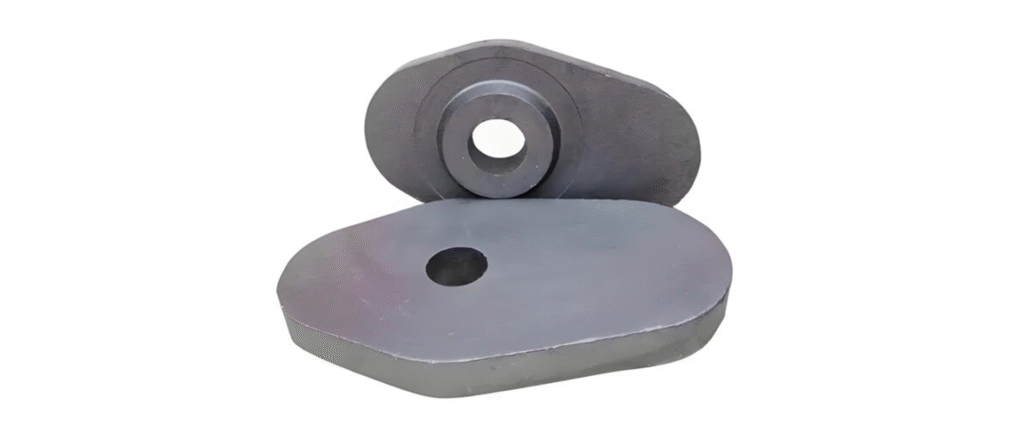
The ladle sliding nozzle system consists of upper and lower slide plates, a mechanical drive mechanism, and matching upper and lower nozzles. Installed at the bottom of the ladle, it controls the flow of steel during continuous casting. The slide gate plate are the primary flow control components. The upper slide is fixed to the mechanism, while the lower slide is movable, controlling the velocity and volume of molten steel flowing from the ladle to the tundish. Currently, there are numerous slides on the market, most of which are related to the mechanism model. The slides and their accompanying nozzles are custom-made products, manufactured to customer specifications. Pre-production requires detailed design of their dimensions to ensure the perfect coordination between the slides, nozzles, and mechanism, ensuring optimal flow control in-situ. Through years of design experience, we has summarized some experience and techniques in ladle slide and nozzle design for designers’ reference. The structure of the ladle sliding nozzle system is shown in Figure 1.

1 .Basic ideas for sliding gate drawing design
1.1 Modeling Approach
After receiving a slide gate design assignment, we should first analyze the overall outline of the product before considering the details. A unified plan and design should be developed for the entire product, utilizing fully parametric modeling methods whenever possible. The details are as follows:
(1) Feature Analysis
Analyze the shape characteristics of the slide plate and then isolate it into several main feature areas. Then, decompose each area with rough lines until you have an overall modeling idea and a rough feature map in mind. At the same time, identify the drawing difficulties and areas prone to errors.
(2) Design ideas
Rough first, then fine: Design the rough shape first, then refine it gradually. Big first, then small: Design the large-scale shape first, then refine the local shape. Outside first, then inside: Design the outer surface shape first, then refine the inner shape.
(3) Detailed design
Use forming features (such as holes, bosses, etc.) and feature operations (such as rounded corners, chamfers, etc.) to design the product details.
1.2 Ideas for rounded corners
① First the big ones, then the small ones; ② First the few ones, then the many ones; ③ The same type of sides fall together; ④ First the branch roads, then the main roads.
2.the design of slide gate plate
The goal of slide plate design is to support production while ensuring product usability. Accurately designing to best serve production is essential for design work. Slide plate drawings vary widely, with varying styles and models. Drawings for different models from the same manufacturer may differ. A plate’s appearance is determined by its associated mechanisms. Only with a detailed understanding of the sliding mechanism can an optimized slide gate plate design be achieved, rather than simply following a standard.
Based on current market conditions, slide gate plate drawings can be based on supporting sliding mechanisms from the Interstop series, Flocon series, Chint series, Kurosaki-Sujia series, Vesuvius series, manual mechanism series, and special series. Mastering such a wide range of mechanisms and drawings in a short period of time is challenging. Therefore, slide gate plate are divided into two categories: those with steel shells and those without. Specific skateboard design requirements:
①Determine the skateboard’s general outline;
②Determine the dimensions of each skateboard component;
③Determine the skateboard’s tolerances (refer to Table 1);
④Strictly distinguish between production drawings and finished product inspection drawings.

Production drawings must be detailed to facilitate production guidance and must include: steel shell thickness and distance from the plate surface, steel strip type (width x thickness), hoop location (i.e., distance between the hoop and the non-working surface), asbestos pad and tinplate thickness, etc. Finished product inspection drawings should be concise and clearly marked, with key external dimensions including length, width, thickness, height of the master and slave platform, casting hole dimensions, external dimensions of the master and slave platform, and center distance. Drawing design must adhere to the following two points: ① For products of the same model (sliding mechanism), maintain consistency in design as much as possible; ② Assuming no problems in use, chamfers should be maximized to facilitate demolding during molding.
3.the design of ladle nozzle
3.1 Upper Nozzle Design
The upper nozzle design should consider its fit with the nozzle base brick and upper slide. Therefore, the following issues need to be considered during the design process:
①Casting hole design.
The upper nozzle casting hole primarily considers the mating surface with the upper slide. Theoretically, the small end dimensions can be controlled according to mold design guidelines. When the upper nozzle requires a fireclay fixture, the casting hole dimensions must be strictly controlled and the upper tolerances must be adhered to during design. Special products should be specifically marked.
②Shovel Outer Diameter Design.
The outer diameter of the upper nozzle is primarily determined by the inner cavity dimensions of the nozzle base brick and the aperture dimensions of the mechanism base. In theory, negative tolerances should be adhered to during design.
③Mater-slave Platform Dimension Design.
Mater-slave Platform mainly determines its fit with the slide. Because the upper nozzle is in continuous use during the hot cycle of the ladle, the Mater-slave Platform is a vulnerable part. The outer dimensions can be appropriately relaxed as long as it fits perfectly with the slide.
④Height Design.
The sprue height is a relatively widely controlled dimension among all sprue dimensions and can be designed based on the molding process and accumulated market experience.
3.2 Lower Nozzle Design
The lower nozzle is used in conjunction with the slide plate and must be replaced along with the slide plate during hot repairs. The lower nozzle is installed within the swivel sleeve of the collector nozzle mechanism and, together with the slide plate, controls the flow of molten steel. The following points should be considered during the design process:
- Outer diameter of the large end of the lower nozzle. The outer diameter of the large end of the lower nozzle primarily coordinates with the swivel sleeve; the (small end) positioning bevel coordinates with the ladle shroud. The outer dimensions of the lower nozzle are determined by the steel shell. Therefore, as long as the steel shell is strictly controlled, the positioning section and outer diameter of the water inlet can theoretically be well controlled.
- Casting hole design. The design principles for the casting hole of the water inlet are basically the same as those for the water inlet.
- Mater-slave Platform design. The design of the Mater-slave Platform design for the lower nozzle is similar to that for the lower nozzle, but more stringent requirements can be applied to the lower nozzle.
- Height design. Similar to the lower nozzle design.
3.3 Tolerance control in nozzle design process
Refer to Table 2 for tolerance control of nozzle design process.

4.Conclusion
The graphic design of ladle slide gate plate and nozzles requires continuous learning, accumulation, improvement, and innovation. Graphic design must adhere to the principle of serving production and the actual application of the steel plant. This requires diligent study of design techniques and avoids a cookie-cutter approach. Learning to flexibly apply these design methods and techniques will yield twice the result with half the effort.